Posts

Showing posts with the label astrology

Hubble and Einstein credited for the discovery of ancient galaxies

Image
For the first time, Scientists were able to observe a distant galaxy which was formed in the early days of the Universe, just 500 million years after the Big Bang. The discovery was possible thanks to the Hubble Space Telescope and the general relativity theory of Albert Einstein .  The oldest picture of the universe have been acquired by scientists using electromagnetic noise left from the Big Bang, a kind of diffuse halo that can not be associated with any star, galaxy or other astronomical object.  This occurs in less than 400,000 years after the Big Bang, a period that can be compared to a fraction of a second, according to the age of the universe (13.7 billion years). No star existed at that time, only the hydrogen atoms that were just created. It took another billion years to have another detailed image, but the landscape was already radically changed: the Universe was containing galaxies that included billions of stars.   What has happened in the ...

Messenger probe provides new information about Mercury

Image
Latest observations of the Messenger probe indicate that there is a high density material reservoir inside the closest planet to the Sun: Mercury Since it entered the orbit of Mercury, a year ago, NASA's Messenger probe has taken nearly 100,000 photographs, it mapped the gravitational field of Mercury and elevation measurements. Researchers published last week in Science Express new discoveries about the closest planet to the Sun. According to them, the planet's crust is thicker and thinner at low latitudes to the poles, which, together with activity data within Mercury, suggests a liquid outer core. This core radius is 85% of the planet to Earth, where the core is less than 50% of the radius. However, findings reveal a Messenger mission of ferrous sulphate liquid layer beneath the crust of Mercury. Regarding Mercury landforms, new study shows changes in elevation smaller than on Mars or the Moon, the most prominent topographic feature in terms of being a bump in a l...

First photos of asteroid 2011 MD as it makes its very close pass by Earth

Image
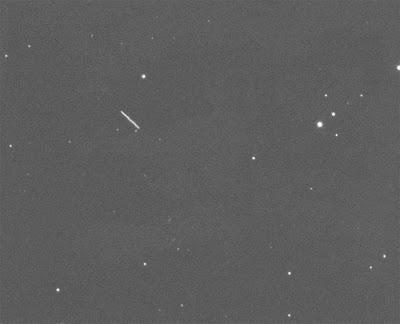
These are the first photos of asteroid 2011 MD as it makes its very close pass by Earth. The asteroid passed at only 7,600 miles above the Earth's surface. It is about 5-20 meters in diameter and in an orbit similar to Earth's around the Sun. Extra observations have determined that this object is not a space junk (as suggested early one). Bill Gray is notorious expert in orbital dynamics. He determined that 2011 MD could not have been close enough to Earth before . At the moment of it's closest approach, 2011 MD was bright as magnitude ~11.8. Although 2011 MD was pretty close, the record of nearby passing asteroids is held by 2011 CQ1. It came within 5,840 KM of Earth on 4th Feb 2011.

Astronomers unveil new 3D map of the universe

Image
Astronomers have developed the most concluding 3D representation of the close universe up to now. Using high resolution telescopes they evaluated distances to a whopping 45,000 galaxies out to a length of 380 million light-years. Contrary to the known Sloan Digital Sky Survey, which represented just a parcel of the sky, the modern 2MASS Redshift Survey addresses 95% of encircling space, skipping only the area near the plane of our own galaxy, where the Milky Way System interference the view of remote objects. In the map, color ciphers for distance: purplish dots are close galaxies; red dots are remote ones. The new representation of the near universe will assist stargazers to interpret and explain the movement of the Milky Way, which is seemingly being drove by the gravity of adjacent groups and clusters of galaxies. Read more about it on ScienceShots

Solar Eclipse Explained

Image
A solar eclipse happens when the moon comes about between the Sun and the Earth. In that moment the Sun is in full or in part covered. This event can be encountered on a new moon, when the Sun and Moon are in alignment as seen from the Earth. At the least 2 and up to 5 solar eclipses can take place every year on the planet Earth,Total solar eclipses are still rare at whatsoever placement since on each eclipse totality exists just along a narrow corridor in the comparatively small surface area of the Moon's umbra. Image Credit